Green Mount Cemetery sits on the outskirts of Montpelier, thirty-five terraced acres climbing a hillside above the Winooski River, just off Route 2 — you’ll know you’re close when the big Gothic stone arch comes into view. It’s been there since 1854, when a local benefactor bought the land so the city would have somewhere to bury its dead once the older in-town cemeteries filled up. Quiet, shaded by old hardwoods, exactly the kind of place you’d expect to find nothing more unsettling than a nice afternoon walk.
Then you find her. Or him, rather — more on that in a minute.
She’s known as Black Agnes, and if local legend is right, she doesn’t appreciate visitors getting too comfortable.
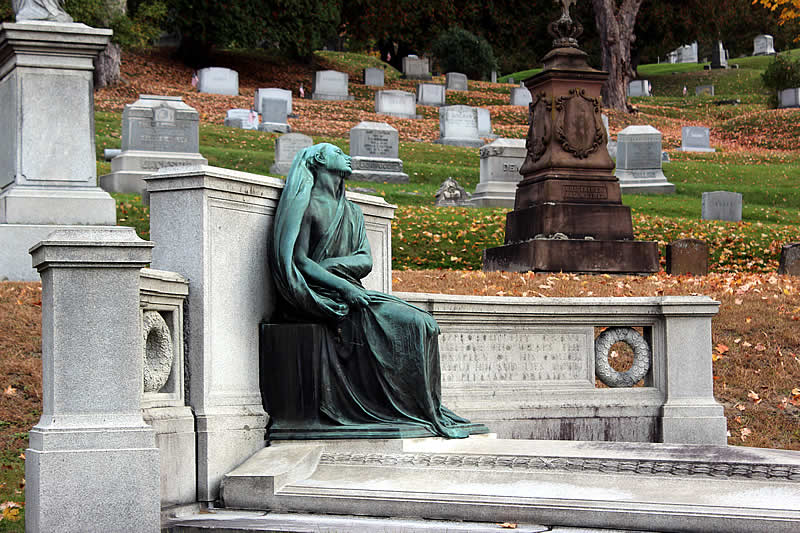
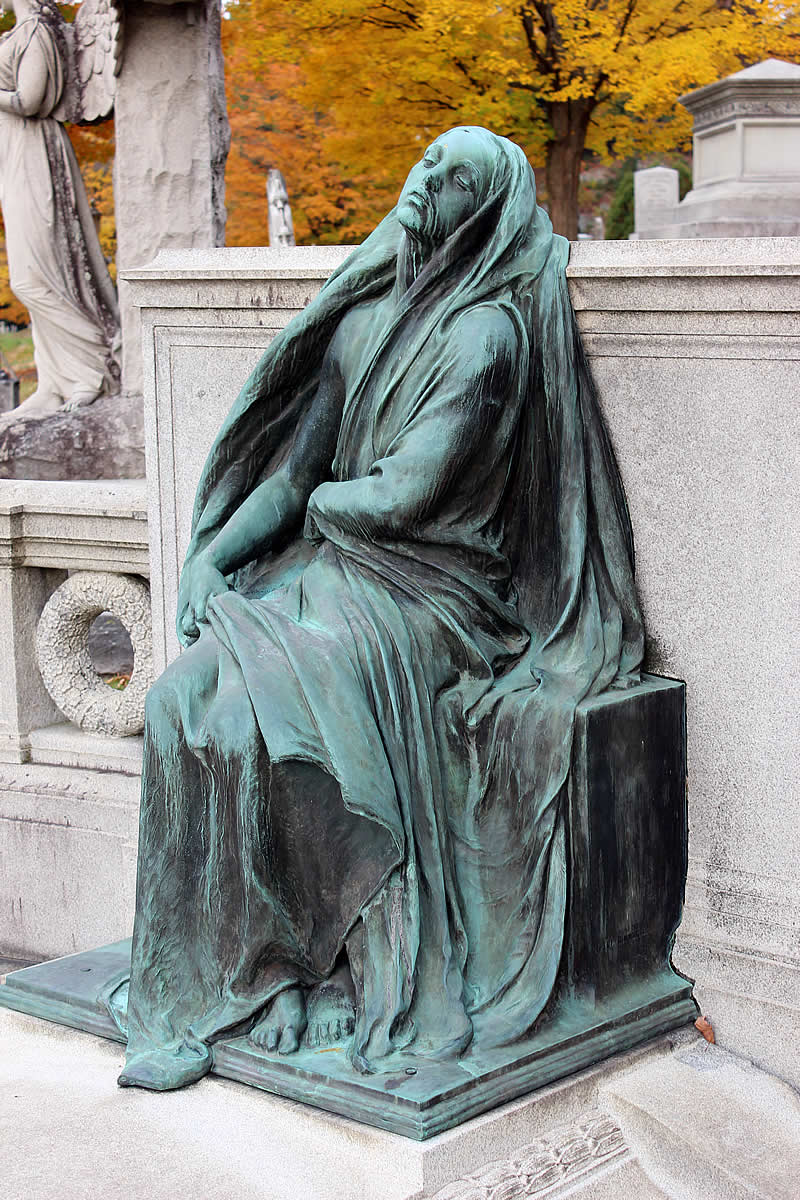
Known locally as “Black Agnes,” the somber figure in Montpelier is actually a representation of Thanatos, the ancient Greek personification of death. The statue’s hooded face appears distinctly feminine, yet the body beneath the heavy shroud was sculpted with male anatomy, adding another curious detail to its already unsettling appearance.
The “Black Agnes” Statue – “Dude looks like a lady!”
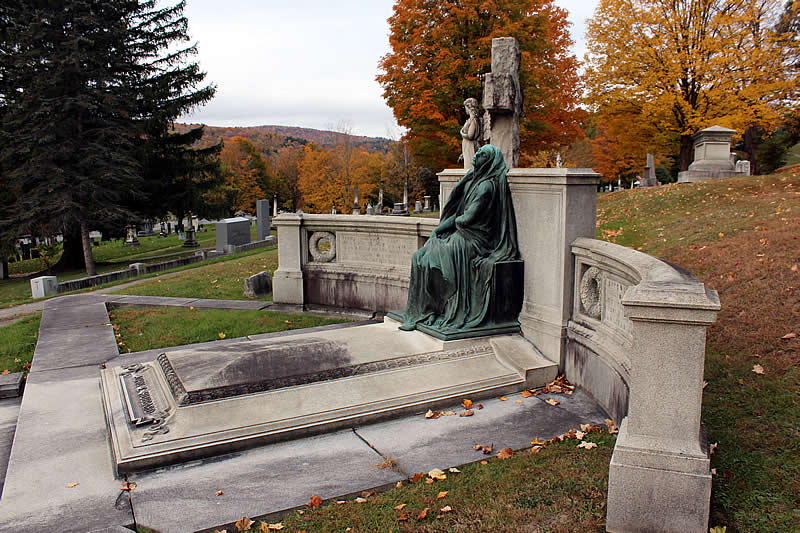
The monument is a bronze, robed figure, seated, eyes closed, head tilted back and covered by a shawl — weathered over the decades to a dark greenish patina that’s presumably where “Black” comes from. Despite the name, the figure isn’t a woman at all. The anatomy is male. Its real title is Thanatos — Greek for death itself — and that’s the name you’ll find if you go looking for it in any serious accounting of the cemetery’s art.
Joseph A. Citro has written extensively about Vermont folklore, ghosts, legends, strange history, and the unexplained.
None of that has stopped generations of Vermonters from calling it Agnes, or from insisting that sitting in its lap is a very bad idea. The legend has some variations, but the gist is always the same: sit on the statue’s lap — some say it has to be at midnight, under a full moon — and within a week you’ll suffer a serious run of bad luck. Some versions promise worse than bad luck. Death, specifically, and not always just for the person who sat.
The Man Underneath
The statue marks the grave of John Erastus Hubbard, a Montpelier businessman who died in 1899 at fifty-three — and who was, by every account, the wealthiest and most disliked man in town.
Hubbard’s money didn’t come cleanly. His aunt died about a decade before him having willed her fortune — some $350,000, roughly $9 million today — to the City of Montpelier, earmarked for a new public library and for a chapel and gates at Green Mount Cemetery. Hubbard contested the will, arguing (among other things) that she hadn’t been of sound mind when she wrote it. He won, and the money that was meant for the city became his instead.
Montpelier did not forget it. Even a man who wasn’t short on cash had just taken a fortune meant for the town’s library and made it his own personal windfall, and the town knew it.

When Hubbard died, though, his own will complicated the picture. The city discovered he’d left a substantial sum back to Montpelier after all — accounts differ on the exact breakdown, but the general figure runs to something like $125,000 for the library, $25,000 for a chapel and gates at Green Mount, and $85,000 to create Hubbard Park, the tree-covered hillside above the State House. It was less than his aunt had originally intended, and it came stamped with his name instead of hers — the library that resulted is still called the Kellogg-Hubbard Library today — but it was real money, and it left Montpelier with a park and a library that are still in daily use more than a century later.
Complicated man. Genuinely resented in life, and yet the reason a fair amount of what makes central Montpelier pleasant still exists.
One more thread worth mentioning, if only because it refuses to die: local lore has long held that Hubbard took his own life by jumping from the stone lookout tower in the park that now bears his name. It’s a good story. It’s also impossible — the tower wasn’t built until years after Hubbard was already in the ground.
Building the Monument
After Hubbard’s death, his executors were tasked with marking his grave, and one of them — William Paul Dillingham, who had served as Vermont’s governor from 1888 to 1890 — took the lead in commissioning it. The job went to Karl Bitter, an Austrian-born sculptor with a serious reputation, who cast the bronze figure now known as Thanatos.
The back wall framing the statue carries lines from William Cullen Bryant’s poem “Thanatopsis” (“Thoughts on Death”), a piece just about every literate 19th-century American would have recognized on sight:
Thou go not like the quarry slave at night,
scourged to his dungeon, but sustained and soothed
by an unfaltering trust. Approach thy grave
like one who wraps the drapery of his couch
about him and lies down to pleasant dreams.
It’s a peaceful sentiment, and by most readings it suggests Hubbard, or whoever chose the inscription for him, wanted the record to show a man who died with a clear conscience — whatever Montpelier thought of him.
The statue became a curiosity almost immediately. One story from 1902 has a Mrs. Sumner Kimball testing a horse she was thinking of buying by bringing it to the cemetery and walking it right up to Hubbard’s grave — reasoning that if the horse didn’t spook at the sight of it, it was calm enough to buy.
Where the Name Actually Comes From
Here’s the part the legend usually skips, and it happens to be the best-documented piece of the whole story.
Karl Bitter didn’t invent the pose out of nowhere. His shrouded, seated figure follows in the tradition of a much more famous piece: the Adams Memorial, a grieving bronze figure sculpted by Augustus Saint-Gaudens for a grave in Washington, D.C.’s Rock Creek Cemetery. That statue became well known enough that, some years later, a man named Felix Agnus — a Civil War veteran and Baltimore newspaper publisher — had an unauthorized copy made for his own grave at Druid Ridge Cemetery outside Baltimore.
That copy picked up a nickname derived from Agnus’s own name: Black Aggie. And it was Black Aggie’s statue, not Bitter’s, that first collected the ghost stories — teenagers sneaking into the Baltimore cemetery at night, daring each other to sit in her lap, tales of glowing eyes and worse fates for anyone who tried. The legend got popular enough that it eventually traveled.
Somewhere along the way, that traveling legend found Montpelier, attached itself to Karl Bitter’s very different, very Vermont statue, and “Aggie” softened into “Agnes.” Nobody can point to the exact year or the exact person who made the swap. But the shape of it is clear enough: Vermont’s monument to death borrowed its scary reputation from a completely different grave five hundred miles south.
Which means the “curse” of Black Agnes isn’t really about John Hubbard at all — it followed the statue north on its own, looking for a lap to sit in.
The Legend of the Lap
None of that origin story has slowed the tale down any. The most-repeated version of the legend involves three local teenagers who, so the story goes, drove out to Green Mount one night to test the curse for themselves. Under a full moon, they all sat on Black Agnes’s lap together, felt nothing happen, and drove off feeling pretty proud of themselves.
Within the week, all three had come to grief. One broke a leg falling down a stairway. One was struck by a car. One drowned when his canoe capsized in the Winooski. All three incidents, the story insists, happened within two miles of the statue.
Maybe that’s coincidence. That’s rather the point of a legend like this one — it’s built to make you wonder.
Would You Sit Down?
Ask around Montpelier and you’ll find plenty of people happy to tell you the whole thing is nonsense — right up until you ask if they’d actually sit on the statue’s lap themselves. Most, even the skeptics, will hesitate. Then decline.
Green Mount Cemetery is worth the visit regardless of what you believe about curses — the ironwork, the hillside views of the Winooski, the sheer amount of striking funerary art packed into thirty-five quiet acres. Black Agnes, weathered green and eternally seated with his/her eyes closed, is only one stop among many.
But if you do find yourself standing in front of her, and some part of you is tempted to take a seat and see what happens —
Vermont’s own local wisdom suggests you don’t.