by William Alexander
Stand at the end of Mill Street on a quiet night, when the moon hangs low over the Stevens Branch, and the water makes a sound like something half remembered.
Let’s be honest about what is known. No one has documented a ghost at the old woolen mill in Barre. No record of clattering looms in the dark, no phantom workers fleeing a fire. What the record does hold is stranger and more human: a heartbroken hunter, a plowed-up jackknife, and a mill village that rose, struggled and vanished along the same stream. It is the kind of place where a legend needs very little to get started.
The Legend of Stevens
The Stevens Branch is a tributary of the Winooski River, and by Vermont tradition it is named for a man who died alone beside it. Every telling agrees on the outline: a hunter named Stevens took to the wilderness in the late 1700s, and he was found dead.
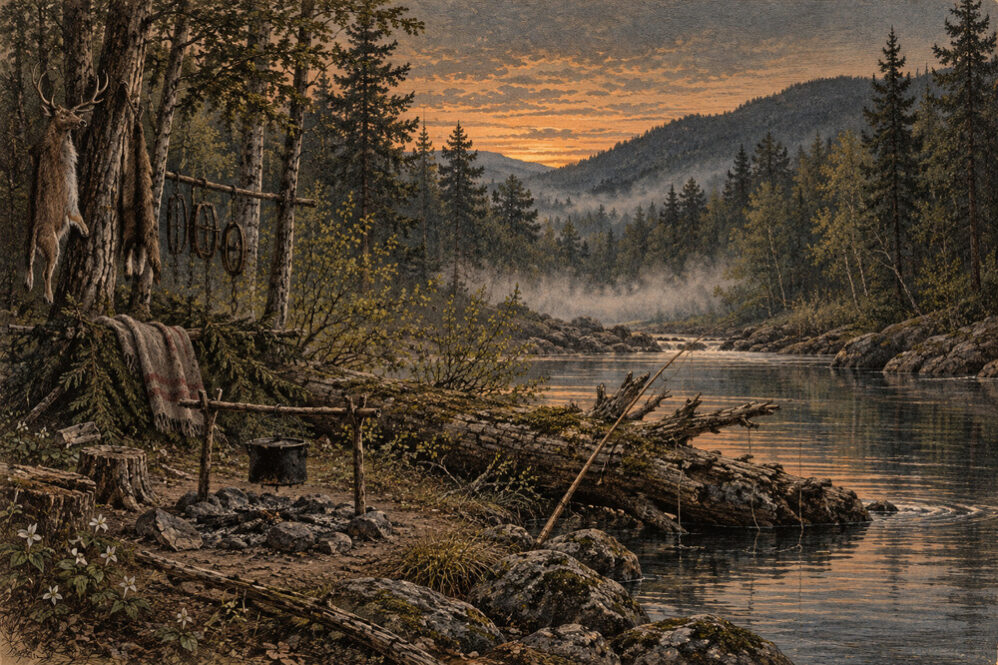
The most vivid version comes from Ralph Nading Hill’s 1949 book The Winooski: Heartway of Vermont, as quoted by Barre historian Paul Heller. Stevens was a lovelorn trapper who, spurned by the woman he loved, set off alone. Nothing was heard of him until the following spring, when two hunters found his body on the bank of the stream. A fallen tree made an eddy, a likely fishing spot, and Stevens lay with one hand resting on a fishing pole, its half-rotted line trailing into the water.
Nearby stood his camp: traps, a gun, a hatchet, a blanket spread over boughs, and skins hanging on a tree. Over the charred remains of an old fire hung a kettle holding water and herbs for sickness. The hunters buried him close by.
Other early accounts differ in the details, which is how legends behave. One Vermont Historical Gazetteer entry says a hunter named Stevens had a camp near the mouth of the stream and was found dead in his hut on a bed of beaver skins. Another says the first settlers found his cabin and his body, that he came from Corinth, and that a disappointment in love drove him into the woods. Notice the location: near the mouth of the stream, close to the Winooski and miles downstream from Barre’s mill village.
The Jackknife in the Furrow
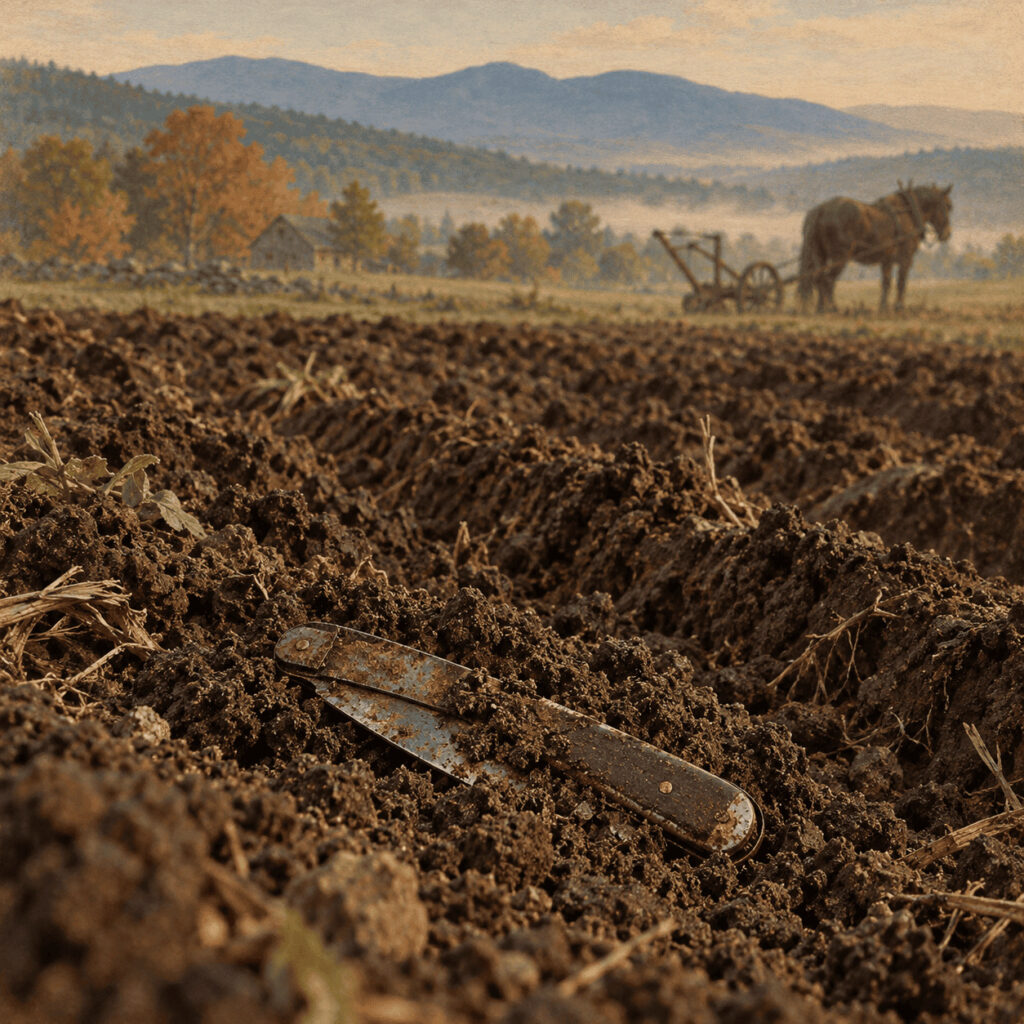
The story does not end with the burial. Years later, young Daniel P. Thompson, who grew up to be a writer, lawyer and chronicler of Vermont, was working at the family farm when his father’s plow turned up Stevens’ bones. Lying in the furrow was a rust-eaten jackknife.
Thompson recalled the moment in his history of Montpelier. According to Heller, the sight of those remains was the first spark of his lifelong fascination with local history. It is an eerie image, and also a lovely one: a boy kneeling in a freshly plowed field, holding a stranger’s knife, and deciding that the past was worth remembering.
Factory Village on the Stevens Branch
The stream that took Stevens’ name later turned wheels. Woolen mills first came to central Vermont in the 1830s, when a boom in Merino sheep created demand for carding, spinning and weaving, and mills sprang up wherever running water could power machinery. The Stevens Branch in Barre was one of those places.
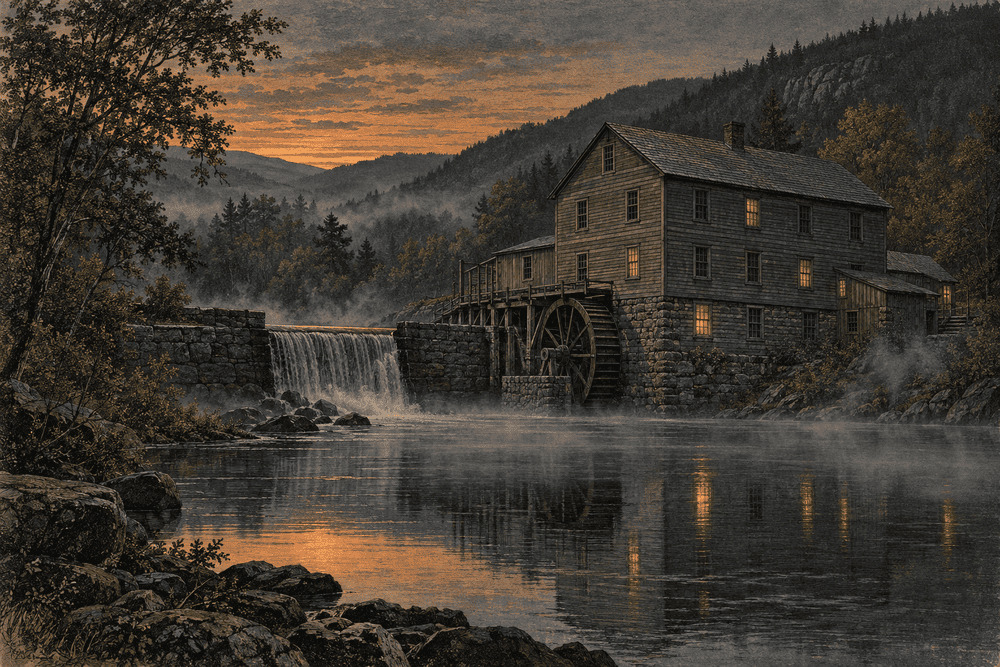
On the 1873 Beers map, the settlement is labeled Factory Village, though old-timers called it Mill Village. A three-story woolen mill stood above a dam and mill pond, taking advantage of a 34-foot drop from the top of the dam to the turbine below. The map shows buildings labeled for Tilden Bros. and for Moorcroft’s woolen mill. The exact year the mill was built is unclear, but it was operating by 1858.
William Moorcroft and the Fire That Wasn’t in Barre
The name most tied to the mill is William Moorcroft, an English-born textile man (born 1822) whose father was a skilled dyer. By one account he arrived in Andover, Massachusetts, as a boy, and learned about Vermont mills from James Gould at Gouldsville, now Northfield Falls. He first reached Barre in 1858, working for Joseph Parker of Quebec, who ran the Factory Village mill. Later he operated mills in Northfield and built his own at Wrightsville, near Montpelier.
It was the Wrightsville mill, not the Barre mill, that burned. In late January 1871, a Thursday, fire broke out in the wool box. The boy tending the carding machines reached in for more wool and burned his hand, and before he could raise the alarm the flames raced up through the building, nearly cutting off the workers’ escape. The mill, 85 by 40 feet and five stories counting the basement, produced white flannel for about twenty-five employees. Very little could be saved. The newspaper put the loss near $35,000 and called it almost irreparable for Moorcroft.
He started over. After a stint at the mill in North Montpelier, he came to Barre in 1873 and ran the Factory Village mill for the next nineteen years, first as a lessee of owner Dennis Tilden until he could afford to buy it. His 1898 obituary praised him as a businessman of the strictest integrity.
What Became of the Mill
How the Barre mill ended is less clear than the story of the Wrightsville fire. An 1884 map still lists Moorcroft’s woolen mill, and a map from around 1900 shows buildings on the site standing vacant. Beyond that, the written trail goes quiet.
Where Legend Meets History
Put it all together and you have a stream named for a man who died of heartbreak, a farmboy who found his bones, and a village of mills that rose beside the same water, suffered a devastating fire down the valley, and slowly emptied out. None of it is a ghost story in the strict sense. All of it is the stuff ghost stories are made of.
So if you ever stand beside the Stevens Branch at dusk and imagine looms in the distance or a lone figure fishing in an eddy, you are in good company. storytellers have kept him there for generations.
Do you know a real local story about Mill Village or the Barre woolen mill? Share it in the comments or send it through the contact page.

Sources and credit
This article draws heavily on Paul Heller’s “Barre woolen mills once self-sustaining” (Times Argus, Aug. 9, 2016), including his quotations from Ralph Nading Hill’s The Winooski: Heartway of Vermont (1949), Daniel P. Thompson’s history of Montpelier, the Caledonian (Feb. 3, 1871) and Moorcroft’s 1898 obituary. Additional details come from the Vermont Historical Gazetteer entries for Barre and Cabot and from 1873, 1884 and c. 1900 maps of Barre. Special thanks to Paul Heller.